Friday, 31 January 2014

The Premise Behind the Picture


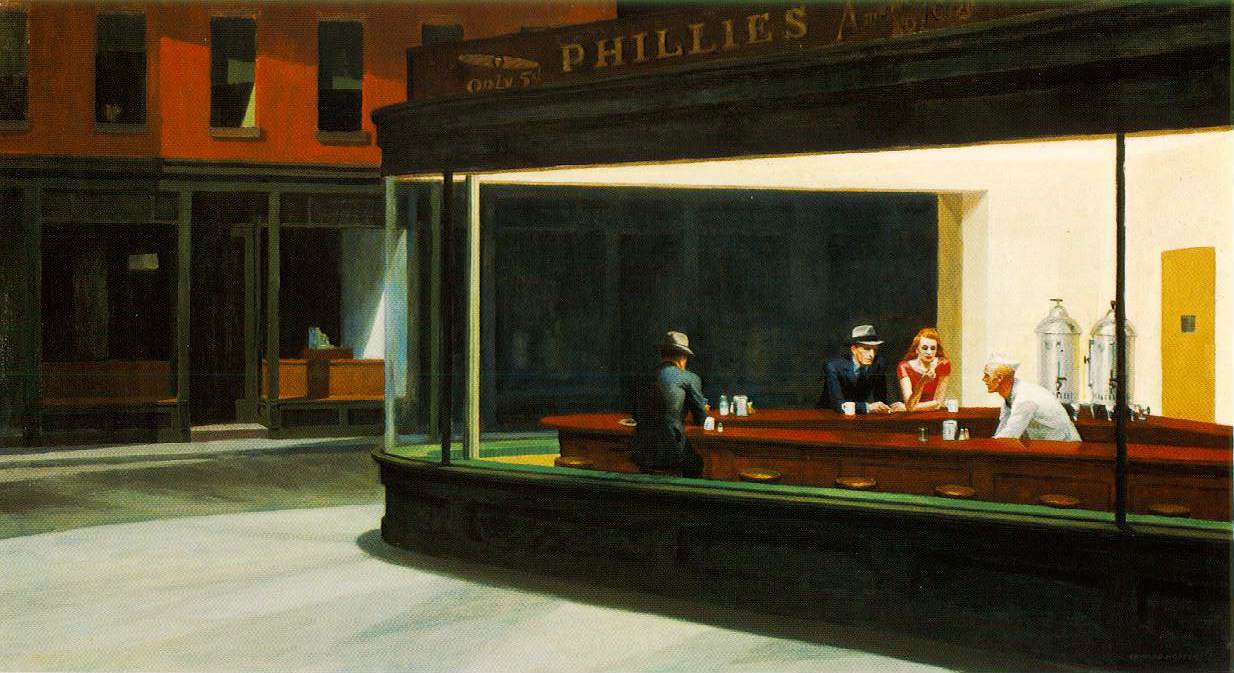
After doing a little more reading on Nighthawks, I was pleased to find that Hopper had actually provided something of a background on the painting, which makes it easier to analyse. I read in a book I took out of the library called 'Portraits of America' which explores Hopper's work. In it, he said this about Nighthawks:

It was suggested by a restaurant on Greenwich Avenue where two streets meet. I simplified the scene a great deal and made the restaurant bigger. Unconsciously, probably, I was painting the loneliness of a large city.' 
I appreciated this comment he made about his own work, and thought it was very honest. I have noticed after a brief look at what is said about his other works as well, that there seems to be a common bleak theme underneath the picture. People seem to get a sense of sickness, loneliness and death although it is not directly present.

Another thing I read in the book was that Ernest Hemingway was an influence on his piece, due to Hopper's admiration for his work, and in this case especially the short story 'The Killers' which you can find here:

http://www.unz.org/Pub/Scribners-1927mar-00227

This short story is similarly set in a diner, and you can really imagine that short story having taken place in the diner shown in Nighthawks.

Renovations.


Following discussions today with Simon, I feel like I could perhaps combine together my interests in nature and architecture and put them together into one idea. I've always loved architecture, and when he suggested it, my mind immediately jumped to the ancient world, especially Egyptian architecture. When they built temples, pyramids and tombs, they built with eternity in mind. Similarly across other cultures in the ancient world such as the Greeks, Romans, Aztecs etc. These landmarks which we identify with those eras have to some extent stood the test of time, however they aren't perfect. Slowly they have eroded, and have had to be restored.

To me, this says something about a mindset these people had that was common across the world back then and to some extent it is now as well. There is and has been a common human arrogance which causes us to think we are going to be able to defy nature and build things which will last forever when that simply isn't true, as I have already said in previous posts.

An example of this can be found in the pyramids. Egyptologisits believe that the original structure of the pyramid stood 480.6 feet tall however with erosion, the current height of the pyramid is 455.4 feet tall. That's enough of my rambling for now, but that's my current idea. I'm just wondering how I could possibly get that message of a lack of immortality across through architecture.

Experimental Sound Brief

For this brief we were all given a painting as a starting point to go away and research and use as a base for my project. My first thought was to research the painting, the man behind the painting, and the time that he lived in to gain a full understanding of the painting.

My painting was Nighthawks (1942) by Edward Hopper:


I had a look on a website that presented facts about the painting and the method Hopper takes to this work:

http://totallyhistory.com/nighthawks/

The writer of the article named Hopper as a historian, and that he used painting and drawing as his method for recording history, due to his many works on the state in which he lived in America. I took a look at some of his other paintings as well and I think I agree with that statement:


Gas (1940)


New York Movie (1939)

A few quick notes I made about Nighthawks as my pre-analysis:

  • Hopper has a very great consideration of light, and edges in his painting.
  • He depicts a night scene at a time when wearing suits and smoking was very fashionable.
  • The area surrounding the diner is quite scarce and empty, which I consider odd since nightlife in his home town was surely more populated than that.
Those are my preliminary thoughts for now, though I think I'll do a much more broad search over the next few days.


Light Spectrum


After looking at what humans miss in life in terms of what we see and notice, I decided to look at it from a different angle and a question I had previously considered; How much do we see in terms of light?

The answer is, well, not a lot. We see visible light but there is a whole other spectrum out there to view. Butterflies are thought to have the widest range in terms of seeing across the spectrum of light. Now, I know there is a way to shoot utilising waves such as Ultraviolet and Infrared, and so I had a look at them.


I found this film shot in Infrared film in Congo to capture the impossible, something we can't see. This article to accompany it that I found on No Film School talks more about it in depth:

http://nofilmschool.com/2013/06/infrared-cinematography-documentary-the-enclave/ 

I also had a look at shooting in Ultraviolet, and found a photography project which I found very interesting.


This project, and others have mainly focused on the human form and have been able to show the layer of skin directly below the epidermis, which creates and interesting effect and reveals a lot about the human form that we don't usually see.

Those are my thoughts are the moment, and I think perhaps I could take this idea further in some way and try to interpret it into something I can actually make for a film, since I have set cameras I have to film on and so it is unlikely I could shoot in infrared if I wanted to, and also it would be fairly ambitious to do so.

Image Glitching Exploration

Following my conversation with Rosie on my photography project, I decided to explore the idea of glitching images and removing data in an accidental or random way. I agree with what she said when she suggested that the random and accidental essence of image glitches was something I shouldn't really want to lose to follow my idea and create a full effect.

After some quick googling, I quickly came up with some ideas of how corruption in images can occur:

open the file as text using notepad and delete the first 10 or more lines of text and replace with a bunch of random letters and numbers.

 This post was in a forum from a few years ago and I was unsure as to whether this would work now because of the advancement of operating systems and programs in windows. I was proved right when I tried it a few times and the file came up as corrupted and not view able.

Next I looked at possible online programs I could use to create a similar effect.

The first few images are from a site called Corrutus 3.5, which is a web program where you upload a photo to the site and you click a mode you want it to take in the method of glitching your image and you get a few results to choose from:


The good thing I found about this method is that it is completely random, providing you don't know all of the modes and what they do. The site tells you how the glitching is achieved and you leave the rest to them.

I then tried another site which is an image glitch experiment. In this one, you can upload an image and control the amount of glitching, and how it is glitched, or you can also completely randomise it:


I liked the effect that this gave, although I was disappointed somewhat as the glitching was all very similar, with just different colours and different parts of the image showing, which I felt wasn't random enough and didn't reflect fully what I wanted to show.

The drawback of both of these methods is that they are relatively easy to achieve, and while it creates a nice effect, I feel like it wasn't self-created and I don't know whether I'd be happy letting something else create this corruption. So, I looked at more ways I could create this effect and came across the suggestion of a HEX editor in a forum, which would allow me to change the values of the data in the jpeg to create something perhaps that is viewable, although I haven't had chance to experiment with it yet. However, I would like to experiment with corrupting CR2 files as well as jpegs to see what effect that may give as well.

Thursday, 30 January 2014

The Three/3.5 Ideas.

Now that I've done some research I've come up with some ideas for this multi-screen project.


My first idea is based on the original research I did on nature reclaiming the earth. If I were to do this project, I would want to animate leaves and vines moving through the three screens, wrapping around objects. As I already noticed in the after effects tutorials I have looked at that I could do this and make this look very animated. Essentially, I want to have three different elements of the earth being retaken; a dissolved statue, a carved tree being overgrown with moss and a human hand being wrapped up by vines. Another element I want to consider trying is having three kind of planes in each screen. So almost as if there are three different plates, back plate which is moving one way and has some animation of a backdrop, the middle plate which would be the object and the front plate which would be leaves, vines and perhaps a vignette type effect.
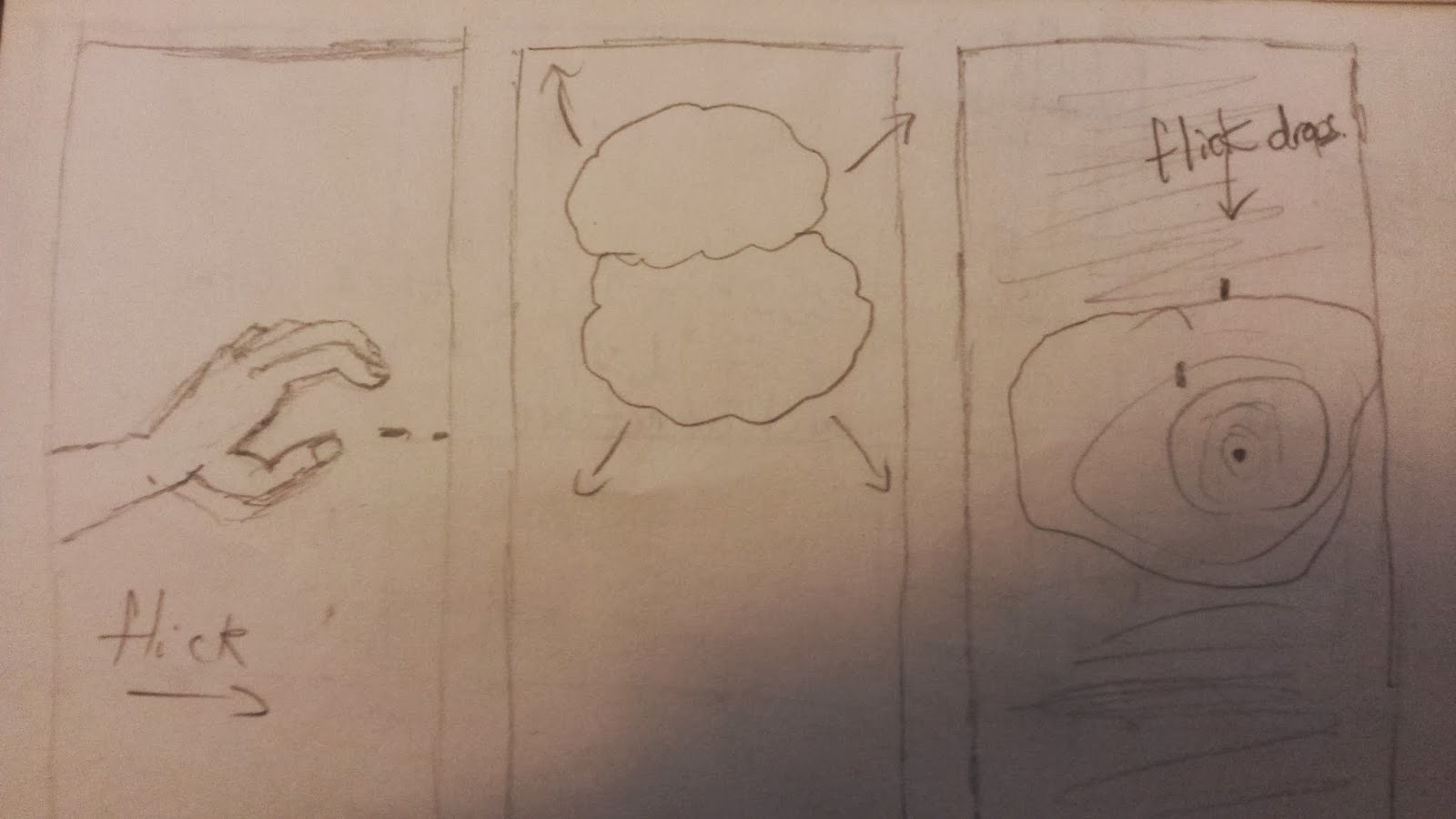

My next idea is to explore the water cycle. This is a lot more simplistic and minimalist than the full on idea of the nature reclaiming, but I think it could be very interesting. I want to explore water in terms of rhythm and consistency through the interaction of the three screens. For example, like the image above, a hand could flick water from the left screen and then drops could splash in a puddle on the right, with clouds brewing in the middle. If I could show this in different forms, and have things moving from one screen to another and have things changing, I think this could quite effectively show cycles and rhythm in nature.

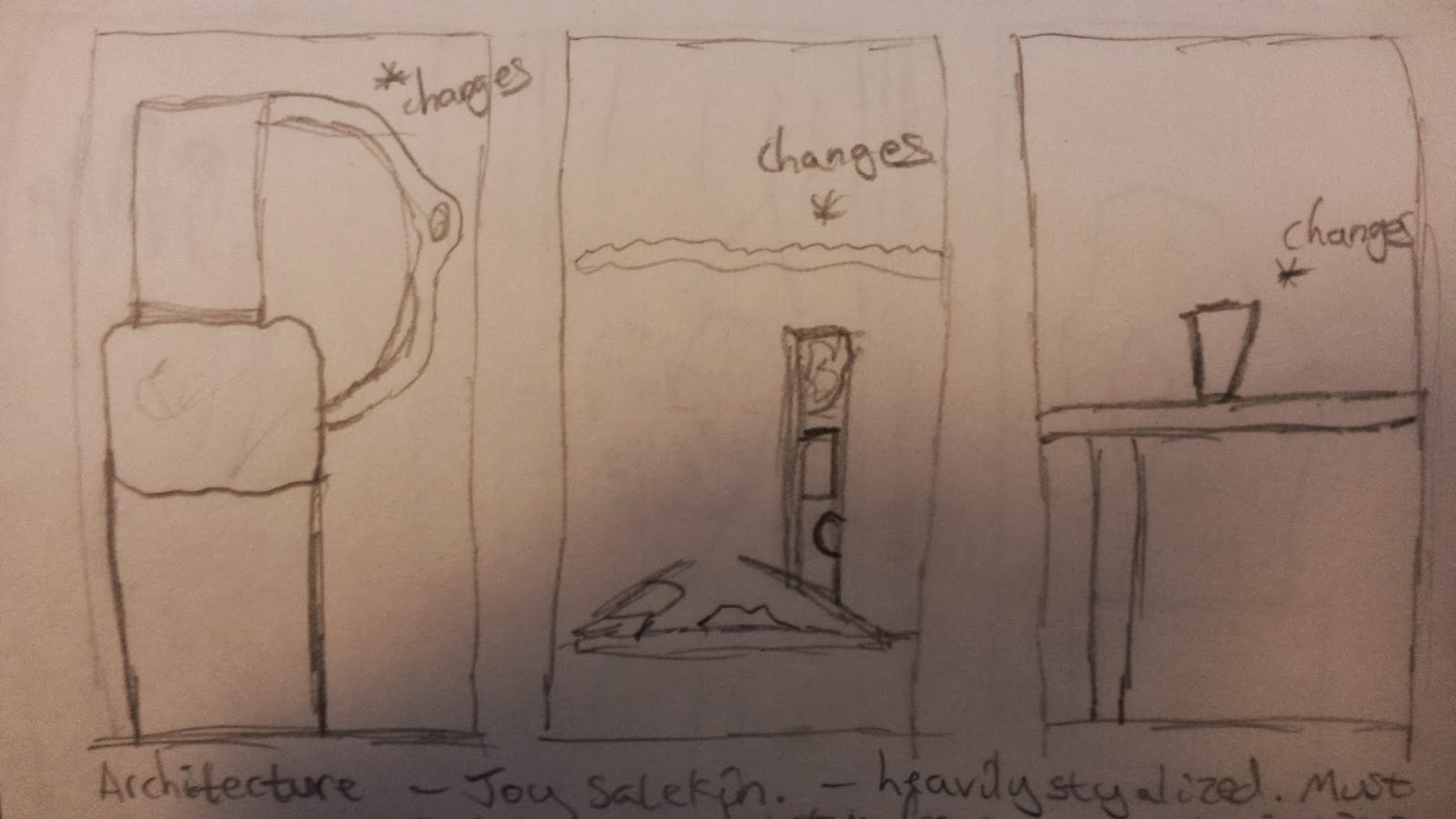

My final idea is in part, two ideas relating to the same theme. However I feel there is room to combine these ideas into one piece, and really I just couldn't discard one of them. This idea surrounds changes in architecture through time, however bringing them all into once space and jumbling them up and fitting them together like a puzzle. I guess this idea is about bringing lots of differing pieces of architecture into one space as a comparison, and bringing them into the same time period.

The top picture shows an idea of having three panels of different walls, different pieces of architecture, and having parts of them fragment. Similar to multiple TV screens of noise, but with digital fragmentation like in a photograph as well. Every time this would happen, a new piece of architecture would be inserted in its place to a rhythm or piece of music. However, I'd like this to be able to loop smoothly as well.

The bottom picture shows a more complicated idea. The middle screen is the main focus and is an empty space, like a field, which fills with the fragmented parts of different architecture to form a structure of their own, but moving and changing all the time. As I think of it, I can imagine it moving, growing and decreasing like a beat in a song and especially in the video of 'She Wolf' by David Guetta:


The two screens either side of it could show either the same or different things. My original vision was to have close-ups of different parts of the structure changing, so that the viewer gets a better view of what is happening. However I felt I could dedicate that to one screen, or both screens and then moving on to just one. The screen on the other side I feel could show what's inside the structure, changing also to represent the changes of eras and the times that these fragments of buildings represent. However I recognize that might be quite difficult to achieve so I perhaps show that in a simpler way.

Internetting.

When considering how I could achieve my ideas through after effects based work, I had a quick look around Youtube and had just a general google on some tutorials that I could perhaps use to apply to my work.


If I were to do my project on the water cycle, and involving water, I was thinking of perhaps how I could simulate liquid using after effects. I have little understanding of how this is done, and have only really seen before how it can be created using modelling tools such as Blender. I found these tutorials in the Creative Cow channel which gives me some idea of what I can do, and what kind of look I can get with it. Obviously I'd need to do more research and tests, but this is a good place to start.


Next I had a look at I could perhaps generate 3D architecture in After Effects, and how I can create 3D from a 2D image if I were to try and do a project on architecture. This is quite relate able to the tutorial I did the other day about animating a still image, but with a different result. I think, depending on what kind of thing I wanted to do, I could find this quite useful.


I then looked at if I perhaps wanted to simulate leaves or growing things in a project on nature reclaiming the world, then I looked at how I could do it. I realised by looking at this that of course, due to the limitations of my time and the limitations of the program that it would probably be a lot easier to create a project that was stylized to look like a sort of animation. I think this could be done quite effectively, and I have some idea of how I could do it.


Lastly, I looked at this tutorial on camera mapping as a general tool for any of these projects. If I want to create something 3D then using a camera is going to be necessary, and if I know how to use that camera to a fuller extent then it would give me a lot more options in terms of what I can do for my project. So, this tutorial was something I could find really useful.