After the screening today of my sound piece, I am doing the same here as I am for Time Art, and just giving a few points of reviewing the project.
The main thing about this project that was significant for me was the creative aspect of using solely sound to create an environment. I have never really underestimated the importance of sound, and I've always understood its necessity, however I never saw it as much more than a necessity. There is a bigger creative and more complicated aspect to what you can do with sound than I had ever really thought about, and this project has really opened my eyes to that, and I really enjoyed that process! I am proud of my project, when I got the piece Nighthawks (1942) by Edward Hopper I knew exactly what I wanted to do with it, and being able to, for the first time, put all of these odd sounds I had recorded into Audition and come out with something that sounds half decent is a big achievement for me.
Using the recorders also was something I had never done before, and for this project I mostly used a Roland recorder which took a small amount of figuring out, but I definitely got there in the end. At one point I recorded a couple of sounds and listened back to them only to find there was some unwanted gain on there, so playing with settings and modes helped me get the result I wanted, even if it took a bit of time.
If I had to do this project again, I know there are some sounds I would re-record, or spend more time on getting right. For example, the footsteps of the person weren't right for the character I was portraying, the sound of the door as the character entered the diner, and the conversation in the piece stand out to me as things I would definitely do again. My main issue with those sounds was being on limited time to record them, or deciding very late on to record those sounds either again, or for the first time in the case of the conversation. Now that I have a bit more experience in sound design I think my organisation of it would be better in future projects.
The final thing I would like to mention is the use of separately sourced sounds in my sound piece. A few of the sounds I sourced from either YouTube or FreeSound.org and I think it is right to link where I got those sounds from:
Newsreel: http://www.youtube.com/watch?v=pj_btks99p4
Car noise: http://freesound.org/people/juskiddink/sounds/77096/
Music: Stardust- Frank Sinatra and Tommy Dorsey
Background conversation in diner: http://freesound.org/people/Corsica_S/sounds/165238/
Fabric Movement: http://freesound.org/people/Yuval/sounds/188222/
Showing posts with label Image Factory. Show all posts
Showing posts with label Image Factory. Show all posts
Friday, 11 April 2014

Time Art: Final Comments
After the screening of my work (although mine did not play for unknown reasons) I feel I should give a few quick last comments about my experience of making the piece.
Overall I feel I did really well in achieving in this project. My matte painting idea was quite ambitious, and something I had never done before, so I used a hell of a lot of things to help me. I spent most of my time in Photoshop just trying to create the world I wanted to portray, and despite it taking a long time I think it was worth it. My process in making the matte painting involved a lot of just looking at the work other people had done, which was something similar to what I wanted to do, and then finding a way to re-create it in After Effects or Photoshop. A couple of tutorials I found most helpful can be found at the URL's below:
http://design.tutsplus.com/tutorials/create-a-realistic-underwater-scene-in-photoshop--psd-28309
https://www.youtube.com/watch?v=pjdmXYRzAWg
http://www.photoshoplady.com/tutorial/create-a-destroyed-city-scene-using-photoshop/2718
My idea was conceptually quite good, relevant topic to use as a basis for my work. My two screens on either side of my matte painting I think got the message across, although this is something I found particularly difficult to judge. One of my main weaknesses in my work is not knowing whether the audience will understand what I mean when I show them something, purely because I know more in terms of the meanings behind what I am doing than perhaps they would. I got around it somewhat by showing people my work, but with this project in particular I struggled with the balance between giving the audience relevant information, and being too obvious about it.
The only other thing I could say about this project is that if I were to do this again I think I would possibly develop my idea a little further and change it somehow, just slightly. I am happy with the result I got, but I feel that the subject matter I was talking about was so rich that there could have been something so much more interesting to explore within it.
Overall I feel I did really well in achieving in this project. My matte painting idea was quite ambitious, and something I had never done before, so I used a hell of a lot of things to help me. I spent most of my time in Photoshop just trying to create the world I wanted to portray, and despite it taking a long time I think it was worth it. My process in making the matte painting involved a lot of just looking at the work other people had done, which was something similar to what I wanted to do, and then finding a way to re-create it in After Effects or Photoshop. A couple of tutorials I found most helpful can be found at the URL's below:
http://design.tutsplus.com/tutorials/create-a-realistic-underwater-scene-in-photoshop--psd-28309
https://www.youtube.com/watch?v=pjdmXYRzAWg
http://www.photoshoplady.com/tutorial/create-a-destroyed-city-scene-using-photoshop/2718
My idea was conceptually quite good, relevant topic to use as a basis for my work. My two screens on either side of my matte painting I think got the message across, although this is something I found particularly difficult to judge. One of my main weaknesses in my work is not knowing whether the audience will understand what I mean when I show them something, purely because I know more in terms of the meanings behind what I am doing than perhaps they would. I got around it somewhat by showing people my work, but with this project in particular I struggled with the balance between giving the audience relevant information, and being too obvious about it.
The only other thing I could say about this project is that if I were to do this again I think I would possibly develop my idea a little further and change it somehow, just slightly. I am happy with the result I got, but I feel that the subject matter I was talking about was so rich that there could have been something so much more interesting to explore within it.
Thursday, 10 April 2014
Time Art Review
Following my tutorial I followed quite a few suggestions I highlighted in the previous post.
I created that transition on the matte painting, which definitely made the whole piece more effective:


I created that transition on the matte painting, which definitely made the whole piece more effective:
I also found that because I had the light transitioning from lighter to darker I didn't need to make the painting less murky as it never truly reaches the darkness it did before.
Secondly, I had some of my images on the left and right screen coming off the sides of the screen so that I could integrate them into my matte painting using an overlaying effect. It creates something slightly ghostly about the whole piece, and it helps create a connection between the images and the painting itself.
I improved on the uniformity of the images on the left and right screen, and it certainly looks a lot cleaner and easier to look at as a result. I also found a way to time it better which helped create an end to the piece, and as such helped it flow a lot easier:
I tried adding a brick texture underneath my footage to see if that created a connection with the images and the building/construction theme I was going for. However I felt it was too much for the audience to look at, with the images changing on both screens as well as the matte painting. Also I felt my footage was enough of a giveaway and I didn't want to make it too obvious.
The final major change I made was including more footage that highlighted the environmental impact humans and construction make on natural events. Also, adding more footage on the construction side of the piece to include more about the desire and wonder of these large and magnificent structures that nations are seemingly in competition to build.
Overall, I feel these changes have made a significant difference to my piece, and I feel it is a better piece overall for it.
Simon's Tutorial Friday 11th April
After my complete export fail for my official Time Art review, I organised a tutorial with Simon to discuss my work. I made the improvements he suggested to the matte painting side of things and did a lot of work on that during the week to make sure I had enough time to do anything else we discussed in this coming tutorial. This is what I showed Simon:

The main comments he made and that we discussed were as follows:
- The Matte Painting is too murky, the audience should see the bottom.
- The images overlapping each other is quite disorganised and should perhaps be more uniform.
- There could be something underneath the images.
- The matte painting could interact with the images in some way.
- There needs to be a loop.
- Maybe there could be a sense of change in the matte painting itself.
- Include more footage that highlights desire with building large structures.
I agreed with the matte painting being too murky, and on my computer it looked a lot brighter than it would on some others. I also liked the sound of creating a transition in the matte painting, and new of a way instantly to do that.
The only thing I was really unsure about on that list was putting something underneath the images. Although I suggested it, I feel like it might be too much for the audience to take in, and may be quite distracting.
Audition Skills
Now having completed my experimental sound piece, I just wanted to give a review on the thing I found most difficult and the skills I think I gained the most out of this project.
Being quite familiar with the Adobe package I found it quite easy to pick up the layout and tools in Audition as Adobe layouts regardless of program tend to be very similar. However there were a plethora of effects and tools I could explore and use in my sound. Having learned the majority of the basics in our class tutorials, I tried to stick to those as much as possible so that I had a solid leg to stand on when building my sound. One effect I really had a good time exploring and playing around with was the 'Convolution Reverb' effect:

Using this effect to put my sounds into a space really made a huge difference to my piece, and I spent a lot of time trying different settings and different sliders to see what effects they could give. Mostly I found that changing the room size and the mix sliders were the ones that had the biggest impact on my sounds. Especially when it came to editing my diner sounds together. Changing the room size a lot of the time could help me create a sense of different distances from the point of audition. Although I found I was battling a lot with the reverb already on some of my audio purely because of the place they were recorded in. For example, some of my sounds were recorded in a room which ever so slightly echoed, and it really affected what I could push my sounds to do in the film.
Another thing I found really quite difficult was volume levels of individual sounds:

Since I was trying to create a sense of space, but still wanted the audience to be aware of certain vital sounds, I found myself changing volume levels, then changing them again just to try and get the balance right between the sounds, and make it sound as natural as possible yet highlighting the sounds I felt needed doing so.
Being quite familiar with the Adobe package I found it quite easy to pick up the layout and tools in Audition as Adobe layouts regardless of program tend to be very similar. However there were a plethora of effects and tools I could explore and use in my sound. Having learned the majority of the basics in our class tutorials, I tried to stick to those as much as possible so that I had a solid leg to stand on when building my sound. One effect I really had a good time exploring and playing around with was the 'Convolution Reverb' effect:
Using this effect to put my sounds into a space really made a huge difference to my piece, and I spent a lot of time trying different settings and different sliders to see what effects they could give. Mostly I found that changing the room size and the mix sliders were the ones that had the biggest impact on my sounds. Especially when it came to editing my diner sounds together. Changing the room size a lot of the time could help me create a sense of different distances from the point of audition. Although I found I was battling a lot with the reverb already on some of my audio purely because of the place they were recorded in. For example, some of my sounds were recorded in a room which ever so slightly echoed, and it really affected what I could push my sounds to do in the film.
Another thing I found really quite difficult was volume levels of individual sounds:
Since I was trying to create a sense of space, but still wanted the audience to be aware of certain vital sounds, I found myself changing volume levels, then changing them again just to try and get the balance right between the sounds, and make it sound as natural as possible yet highlighting the sounds I felt needed doing so.
Project Development
After my experimental sound review, I did a hell of a lot more work on my sound project with trying to get my story straight as I was going for a narrative based piece. Simon and Joe's comments really helped and I found the elements I included as a result have made the sound overall a better piece.
For starters, Simon commented that I should try and place the piece in a particular time more to allow the audience to put themselves in a time as well as a space. As I know the piece was released just after the attack on Pearl Harbour I tried to place my setting around that time. To do this I put a radio news report playing the reel reporting the attack on Pearl Harbour at the beginning, as well as recording some voices crying and talking about the subject, as if it had just happened.
Also, Joe told me to have a look at films by Woody Allen as he set a lot of films around the American lifestyle, like the one pictured in the painting. After listening to the sounds in that and listening to the sounds of diners and restaurants on YouTube, I recorded some tracks of plates and glasses clattering, and sourced some sounds of people talking to try and create more of an atmosphere in the diner itself. I found this quite difficult as the diner is supposedly set really late in the evening, when not many people would be around. However I still wanted to make it obvious that it was a diner and so I had to play around a lot with the volume of certain sounds within the diner, as well as the amount of sound in the piece at any one time, also varying the distance of the sounds from the point of audition. All of which I think contributed to a better effect.
The final comment I found most helpful was Simon's comment of extending the story. In my original plan, the character I was using to guide the audience through the space arrived at the diner and then the piece ended there. Though, the diner is my primary location and I think Simon was right in saying that the audience needed more time there, almost just to revel in the atmosphere of the place and imagine themselves there. I wanted to keep it simple as well, so I simply created a short conversation between a man and a woman discussing the Pearl Harbour attack reel heard at the beginning of the piece. That way you get a chance to stay with the characters and the place for longer, and it also reinforces what the audience heard earlier regarding the time and place of the sound piece.
For starters, Simon commented that I should try and place the piece in a particular time more to allow the audience to put themselves in a time as well as a space. As I know the piece was released just after the attack on Pearl Harbour I tried to place my setting around that time. To do this I put a radio news report playing the reel reporting the attack on Pearl Harbour at the beginning, as well as recording some voices crying and talking about the subject, as if it had just happened.
Also, Joe told me to have a look at films by Woody Allen as he set a lot of films around the American lifestyle, like the one pictured in the painting. After listening to the sounds in that and listening to the sounds of diners and restaurants on YouTube, I recorded some tracks of plates and glasses clattering, and sourced some sounds of people talking to try and create more of an atmosphere in the diner itself. I found this quite difficult as the diner is supposedly set really late in the evening, when not many people would be around. However I still wanted to make it obvious that it was a diner and so I had to play around a lot with the volume of certain sounds within the diner, as well as the amount of sound in the piece at any one time, also varying the distance of the sounds from the point of audition. All of which I think contributed to a better effect.
The final comment I found most helpful was Simon's comment of extending the story. In my original plan, the character I was using to guide the audience through the space arrived at the diner and then the piece ended there. Though, the diner is my primary location and I think Simon was right in saying that the audience needed more time there, almost just to revel in the atmosphere of the place and imagine themselves there. I wanted to keep it simple as well, so I simply created a short conversation between a man and a woman discussing the Pearl Harbour attack reel heard at the beginning of the piece. That way you get a chance to stay with the characters and the place for longer, and it also reinforces what the audience heard earlier regarding the time and place of the sound piece.
Friday, 28 March 2014
Time Art Review
Today I had my Time Art review, which gave me a chance to see how my work would be viewed at the actual screening, on 3 portrait screens. However, my exports for some reason did not save to my hard drive and so I only had the one screen to show, which was frustrating, but I could still benefit from seeing if my aspect ratio and codec worked ok.
Here are my three screens as they should have been seen:


Simon's main comments about my work was that there were some inaccuracies with light and colour in my matte painting. The bottom of the sea bed should be more murky, and my light should have more of a realistic direction in terms of how the picture was in real life.
Also, he didn't seem to get at first that it was meant to be an underwater city, and so I think I need to make that more obvious. It's missing a haze you get when you look at something underwater, and the buildings need to be more rusted and destroyed. Also, the trees are becoming seaweed branches to make it more obvious. I may also add some fish in if I think it will help.
The only other thing I can mention is the codec I used made it difficult for the computer to play my video back. I need to make it into something like Apple Pro Rez when I do my final export.
Here are my three screens as they should have been seen:
Simon's main comments about my work was that there were some inaccuracies with light and colour in my matte painting. The bottom of the sea bed should be more murky, and my light should have more of a realistic direction in terms of how the picture was in real life.
Also, he didn't seem to get at first that it was meant to be an underwater city, and so I think I need to make that more obvious. It's missing a haze you get when you look at something underwater, and the buildings need to be more rusted and destroyed. Also, the trees are becoming seaweed branches to make it more obvious. I may also add some fish in if I think it will help.
The only other thing I can mention is the codec I used made it difficult for the computer to play my video back. I need to make it into something like Apple Pro Rez when I do my final export.
Experimental Sound Review

Last Friday I had a progress review of my experimental sound project before Simon and Joe to get some feedback and for them to see where I'm at with the project. After explaining my idea and showing them what I had created so far, it was obvious to me that some of the levels in my project needed changing. The music in my piece is much louder through the speakers in the room we were in than my own at home and so drowned out a lot of the other sounds that I wanted them to hear, which was quite frustrating but at least I know now.
Aside from that the feedback I got was constructive. Simon felt that I needed to place my piece in the time it is set much more, to let the audience know that is where we are. Joe seemed to like the piece and suggested that I look at more sounds that are created in the space of a city at night and a diner like the one in Nighthawks. He told me to dive into the culture of that time and really ram it home to the audience. Both Simon and Joe also agreed that there should be more of the piece set in the diner, and that there could perhaps be some sort of interaction between characters in the space.
Overall I thought it went well, I was aware that I still had a lot of work to do and that there was a lot more to bring to the piece.
Saturday, 15 March 2014
Mixing
In yesterday's workshop we learnt about mixing, and compression. A compressor controls the level of our sound to ensure it is under the -10db legal limit. However, this can be problematic as you may be able to hear this being done, which is obviously quite unwanted. For example, the sound in Breaking Bad does this and it can be quite noticeable if you know it's there.

Because of this, we have to be careful with how much we use it and try and get the values right on the individual sounds rather than relying on the master.
Sibilance and EQ
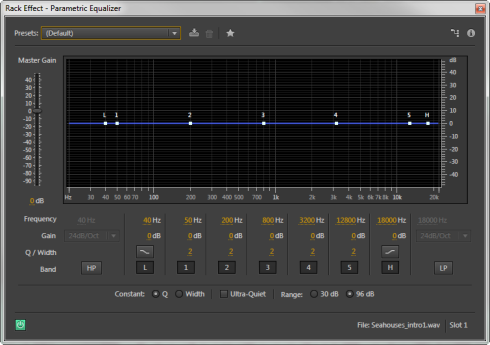
Today's workshop dealt with qualities of sound. I already knew about bass, mid, and treble and this workshop addressed how you can manipulate sound through EQ's to enhance certain areas on that range. For example, mids are vocal tones, so you can enhance voice over or dialogue by using that part more than say, bass (depending on the voice).


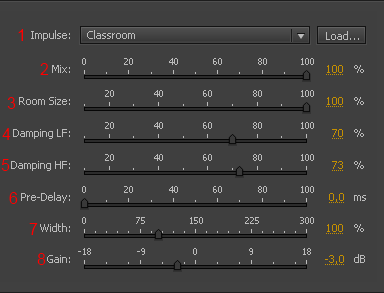
Then we looked at reverb, and how reverb helps create space by changing how a sound may reflect off of the environment it's in. Audition has a hell of a lot of options when it comes to creating different reverb, but it also has a lot of presets to start you off with.
Lastly, we looked at how we can get rid of certain noises in Audition. Using waveform mode, we can activate the spectral frequency display, which allows us to 'see' what our sounds look like. From here we can visually get an idea of any bad qualities in our sound, or harsh notes on dialogue such a sibilance created in the treble range.

Track Laying
Our first workshop into Adobe Audition was all about track laying, putting audio into different channels to build up an atmosphere. It was an interesting exercise as you really saw how you go about building up sounds to create an environment when editing audio to video.
In the exercise we were given sounds to work with, and the first 16 seconds of Toy Story 3 to put the sound to, creating that world, that environment. We went through the basics of layouts of audition and editing tools such as the razor tool, and how to produce fade ins and fade outs. I worked on this mostly in class, and then finished it off at home:
This exercise was really useful, and opened my mind up much more into how you can create an environment purely using sound. Even if the sounds individually may not sound quite right, when they are with other sounds or are integrated with images it is clear to me that they can actually sound pretty good. This should help me when it comes to my project to not dismiss recordings too early if I think they aren't great, as I could get something out of them somehow.
In the exercise we were given sounds to work with, and the first 16 seconds of Toy Story 3 to put the sound to, creating that world, that environment. We went through the basics of layouts of audition and editing tools such as the razor tool, and how to produce fade ins and fade outs. I worked on this mostly in class, and then finished it off at home:
This exercise was really useful, and opened my mind up much more into how you can create an environment purely using sound. Even if the sounds individually may not sound quite right, when they are with other sounds or are integrated with images it is clear to me that they can actually sound pretty good. This should help me when it comes to my project to not dismiss recordings too early if I think they aren't great, as I could get something out of them somehow.
Development
Last week, I had a tutorial with Simon that allowed him to see where my project was going. I had only been really putting the footage I wanted into my film and arranging it. The nature of my film means I want the audience to understand what they are seeing, and experience it fully. However, I had first thought to have the images playing one after another, showing maybe one shot or two of that footage to get a sense of the amount of footage of this type there is.
However, Simon thought it would be more beneficial if I could think of way to let the audience experience all the footage together that is not just a linear progression, and that the screens showing the differing types of footage needed to show a link somehow. I thought about this, and decided it would be best to put the footage into a collage on the screen, changing it every so often so that the audience sees all the footage at once and has time to take it in:

However, Simon thought it would be more beneficial if I could think of way to let the audience experience all the footage together that is not just a linear progression, and that the screens showing the differing types of footage needed to show a link somehow. I thought about this, and decided it would be best to put the footage into a collage on the screen, changing it every so often so that the audience sees all the footage at once and has time to take it in:
So, the footage looks more like the left screen than the right as shown above.
Personally I prefer this way of doing it much more, and it gives me a much easier job in seeing how the footage interacts with each other when seen altogether.
Monday, 24 February 2014
Development on Experimental Sound Writing
Following my experimental sound free-writing, I decided to try and develop this scenario and re-write it, but focusing more on what the sounds of the world are like around him.
To do this, I looked up some photos of 40's New York as a kind of reference point:
Here is my piece:
A light footed man is walking at a leisurely pace, his shoes clacking on the floor from the hard material on the sole. The light squeak suggests new leather, he must be fairly well dressed. The muffled long inhale and relieving exhale as he draws on a cigarette doesn't hide the distant sounds of cars. He passes a building with many people gathered outside, laughing and joking with a dull hum of bright lights from a sign as he passes underneath it. A small sigh as the joy is taken by his greatening distance, and the sudden wind with its high pitched chill. There is a fumbling of fabric as he attempts to wrap up warm, and his steps quicken. He slows, and an old door squeals as it is opened, with a light ring of a bell to follow. The door thuds closed and he saunters across an even louder surface. A chair scrapes as it is pulled and he slumps onto it, his elbows thud as they hit the wooden edge of a bar. A glass is almost immediately placed before him, followed by the sound of liquid being generously poured in. A long silence followed by a quenched sigh. Relief.
I quite liked this version better, and I can see how I could build up the layers of sound to create my scenario and my surrounding. Now I think I need to build a list of sounds I need and get out there and record some.
Friday, 21 February 2014
Experimental Sound Free Writing
As I have decided to make my experimental sound piece about a lonely place and trying to put the audience in that place. To do this I thought it would be handy to imagine that place and write about it to gain an idea of the sounds associated with that place. I did a little free writing exercise on that just to get the ball rolling which I will then refine and use as a basis for my idea.


Below is a basic list of ideas I thought I gathered from my little free writing piece, and it's something I can build and reflect on as I decide what sounds I'm going to need to make this piece a reality. I might also go out early morning over the weekend and record some sounds of the quiet just to get an idea of the sounds that a quiet, lonely place might entail in a physical reality as well as in my head.
Timings
Following Simon's advice about my project I had a little think about timings for my project and drew up some rough pictures in 3 stages of my project, so that I have some loose timings to work from when I do my rough cut of my multi-screen piece. (Please note that this is definitely NOT how my film will look)


If I follow this rough guide then it should make my life a little easier when it comes to creating a rough cut, so now I need to build my archive of footage and images to use so I can get cracking on this project.
Loneliness in Sound
As a result of knowing the back story behind the painting and having looked at what life was like at the time the painting was created, I decided to focus more on silence in sound and loneliness.
Edward Hopper said himself that the painting was subconsciously representing the loneliness of the city, and I think that is especially the case at that time in America's history. So, I took a listen to John Cage's 4'33" as I knew that it was an orchestrated piece consisting only of silence. I understand that he was attempting to get the audience to listen to their surroundings, and make them aware of the sounds around them. Silence in this way shows to be very effective.
In film also, silence is very effective. Most recently 'Gravity' uses the art of silence to replicate the lack of sound heard in space, only using sounds for dialogue, and when a character comes into contact with an object. Here is an article talking more about it:
https://suite101.com/a/john-cage-433-theories-of-sound-and-silence-a69123
For my piece I want to try and replicate the feeling that Edward Hopper was trying to create when he painted 'Nighthawks' and that is a lonely place. To do this, I want to try and think of a character to carry the piece and write out a descriptive piece of what they see, and what's around them to try and make out what kind of sounds are around them. My aim is to try and create an image of a place in the mind of the audience, but also to try and create a feeling around that place of loneliness, but not complete silence.
Edward Hopper said himself that the painting was subconsciously representing the loneliness of the city, and I think that is especially the case at that time in America's history. So, I took a listen to John Cage's 4'33" as I knew that it was an orchestrated piece consisting only of silence. I understand that he was attempting to get the audience to listen to their surroundings, and make them aware of the sounds around them. Silence in this way shows to be very effective.
In film also, silence is very effective. Most recently 'Gravity' uses the art of silence to replicate the lack of sound heard in space, only using sounds for dialogue, and when a character comes into contact with an object. Here is an article talking more about it:
https://suite101.com/a/john-cage-433-theories-of-sound-and-silence-a69123
For my piece I want to try and replicate the feeling that Edward Hopper was trying to create when he painted 'Nighthawks' and that is a lonely place. To do this, I want to try and think of a character to carry the piece and write out a descriptive piece of what they see, and what's around them to try and make out what kind of sounds are around them. My aim is to try and create an image of a place in the mind of the audience, but also to try and create a feeling around that place of loneliness, but not complete silence.
Wednesday, 19 February 2014
Further After Effects Training
Last Friday, Simon felt that we needed to be taught how to handle 3 screens in one composition to help us with our multi-screen piece.
To do this we made a ball bounce, learning how to make objects change position and change speed as they move across the screen using easing in and outs. Then we applied this same affect across three separate screens, later bringing those three separate comps into one large comp in order to time them properly and make sure they are precise. It's much easier than doing the guess work in separate comps otherwise and will save a hell of a lot of time later in our projects.
This was the result:
To do this we made a ball bounce, learning how to make objects change position and change speed as they move across the screen using easing in and outs. Then we applied this same affect across three separate screens, later bringing those three separate comps into one large comp in order to time them properly and make sure they are precise. It's much easier than doing the guess work in separate comps otherwise and will save a hell of a lot of time later in our projects.
This was the result:
Saturday, 15 February 2014
Field Recording
Our first recording lesson in experimental sound was very interesting. We learnt a lot about amplitudes, and the different types of microphones and their outputs. The main points I learnt from that part of the lesson were:
This first one was the recording of the record shop. Tom flicked through some records and CD's, while I recorded him and a music video was playing in the background. I liked this, although I learnt that air was being pushed out to the mic and made a harsh sound as it did so, so I should have placed the mic further away.
This second one was in Waitrose, and I much preferred this one to the last as it gave a real sense of place because the sounds were exactly what you expected them to be. It was obvious the shop was busy, but the recording wasn't taken so loudly that it was over bearing.
Overall I really enjoyed the exercise, it showed me how technical taking a specific sound recording was and so it will help me make decisions based on what I learnt, when I come to do my own experimental sound piece.
- The difference between cardioid, hyper cardioid, omni-directional, and bi-directional.
- That halfing the distance means doubling the gain when recording sound (Similar to the inverse square law)
- The different types of microphones that I will be using for my project, and what they are best suited for.
This first one was the recording of the record shop. Tom flicked through some records and CD's, while I recorded him and a music video was playing in the background. I liked this, although I learnt that air was being pushed out to the mic and made a harsh sound as it did so, so I should have placed the mic further away.
This second one was in Waitrose, and I much preferred this one to the last as it gave a real sense of place because the sounds were exactly what you expected them to be. It was obvious the shop was busy, but the recording wasn't taken so loudly that it was over bearing.
Overall I really enjoyed the exercise, it showed me how technical taking a specific sound recording was and so it will help me make decisions based on what I learnt, when I come to do my own experimental sound piece.
Thursday, 13 February 2014
Time Art Treatment
Proposal
This multi-screen piece is a foreshadowed view of the problems we face as human beings as we continue to try and overcome what happens naturally e.g. landslides, tsunamis, with the aim of demonstrating how our human approach to tackling nature is an inevitably impossible task.

I will collect clips and images like the one above, demonstrating how nature destroys the world we have built to live in, and our solutions to these problems across our history.
With these I will then create some animated stills for increased effect and to give some of the images more ‘life’ but mostly edit them together as a collage of these ideas. There will be a good mix of older events and newer ones, to demonstrate how continuous our battle with nature is.
These two collage minute loops will sit on either side of my three screen piece and will be accurately timed to correspond with one another.
The middle screen will be an exploration of the extremities we could come to if we continue to deny, and work against natural events. Using Matte Painting in After Effects, I aim to show the problems we have now, but on a grander and exaggerated scale.
Inspiration
I am interested in how nature works, and originally began my research looking at people who use nature as part of their art work such as Andy Goldsworthy:


His work very much works with the natural processes we see everyday, such as rivers running and the changing of seasons.
However, I was also very much aware of how humans have impacted on the natural world, and a large sense of human arrogance which involves the opinion that we rule the planet. I simply did not agree with that, and saw how that was shown in erosion of our architecture through time.
I looked at erosion rates of monuments around the world such as the Great Pyramids of Giza, and the Colosseum in Rome, both of which are things I have seen with my own eyes and have a great understanding of.


I had found a couple of triptychs which shared a similar theme to the one I was exploring:
This first one had an interesting use of juxtaposition between rural, beautiful locations and the dark, grey urban world that a lot of us live in. It gave a sense of large space that nature occupies, in conjunction with the often claustrophobic environment associated with modern life.
The second one is a collage across three screens that explores industry surrounding the sea over time. It has a mix of modern and old clips, referencing war and achievements in new technologies. It shows a real admiration for this industry, which goes back to very early in human history, especially across Europe.
Tests
As Matte Painting is a main part of my piece, I looked up a tutorial on set extension and Matte Painting on Video Copilot as I didn’t have much experience in it:
I can see how it would be fairly easy to apply this effect to my project as long as I can source good images and footage to use.
Another tutorial I did as part of a class exercise was animating a still:
This tutorial I found useful as I continued my research, this is also easy to apply to my project and use it to add some effects to my collage images to make them more realistic, and more believable. Also, I could use them in part with my Matte Painting if I wanted to.
Schedule
The first week (commencing Mon 17th Feb) will be spent sourcing my images and footage, organising them accordingly and reviewing them, making decisions on which ones to use.
The next week I’ll start work on the collages, looking at the footage and making decisions on whether to use the technique of animating a still in After Effects. I will spend most of the week in After Effects I imagine, but I hope to have a rough cut put together in premiere, ready for my matte painting work.
After that, I will spend time on my matte painting, referencing the work I have done the previous week to make sure they work together. I will also be referencing matte painting tutorials to aid me.
I expect the last couple of weeks to be matching up the timing of the three screens in after effects and premiere, getting a tight cut on them and making sure all the effects work properly, reviewing their effectiveness as I go.
Requirements
- Adobe After Effects
- Adobe Premiere
- Animating a Still Tutorial: http://www.videocopilot.net/tutorials/animating_a_still/
Tuesday, 11 February 2014
Matte Painting.
Following my tutorial with Simon on Friday, I agreed to look at more personal and relevant matters surrounding nature and human beings. He mentioned matte painting, which I had a little experience of and it gave me an idea of perhaps I could create an image of what could happen if we continue to ignore nature and think we can overcome it. I thought perhaps that I could use examples of what is happening currently and take it to an extreme to make a point. To do this, I did a tutorial from video copilot in matte painting for set extension.
Here is the original footage:
And here is the final outcome:
After doing this tutorial I can see the amount of time it takes to do an effect like this, and it was actually less complicated than I thought it would be. It gives me a bit of reassurance on the timing front, and also I like the effect it gives. It's not quite photo real, but if you work at it rather than do a quick tutorial like I did, then it should look pretty good.
I think next I'll research lots of examples of the kind of natural events I am talking about that involve destruction of human property and such to see how I can use this in my piece.
Here is the original footage:
And here is the final outcome:
After doing this tutorial I can see the amount of time it takes to do an effect like this, and it was actually less complicated than I thought it would be. It gives me a bit of reassurance on the timing front, and also I like the effect it gives. It's not quite photo real, but if you work at it rather than do a quick tutorial like I did, then it should look pretty good.
I think next I'll research lots of examples of the kind of natural events I am talking about that involve destruction of human property and such to see how I can use this in my piece.
Subscribe to:
Posts (Atom)